Product Design · Design Research · Dec 2024 to Mar 2025
KTX Passport
A system-level digital intervention, backed by behavioral science, to increase the involvement of participants at Kerala Technological Expo
Behavioral Scientist
Vineesh U S
Research Associate
Richa Abraham
Product Owner
Nallasivam T
Product Manager
Nidheesh K
UI Designer
Sreenadh V M
The Event
Kerala Technology Expo: 3 days, 200 exhibitors, 6000 delegates
Kerala Technology Expo 2024 (KTX) is a tech showcase bringing together various industries to highlight emerging trends in Kerala, particularly in the Malabar region. Held at Calicut Trade Centre, Kozhikode, the event runs for three days and draws two distinct stakeholder groups: companies as exhibitors, and business owners, working professionals, students, and general public as delegates.
KTX 2024 ran from February 29 to March 2. The scale was significant: over 200 exhibitors and more than 6,000 delegates over three days, across a multi-hall venue with dedicated zones for innovation alleys, premium stalls, and a main stage program.

The Mission
Piloting a product that makes events worth attending
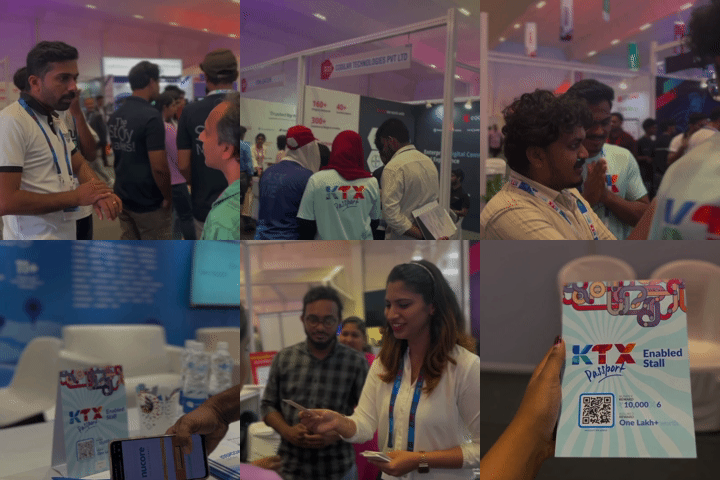
We were at KTX to pilot KTX Passport: a product designed to enhance the event experience by enabling exhibitors and delegates to seamlessly navigate sessions, discover opportunities, and make meaningful connections. The pilot was not a controlled test. It was a live deployment with real users, real exhibitors, and a three-day window to learn everything.
This is what made the project structurally different from most product work: the research and the product were running simultaneously. There was no research phase followed by a design phase. We were onboarding users, observing behavior, iterating the product, and collecting data all at the same time.
The event is the test environment. The product is live. The users are real. The learning has to happen in real time.
The Product
Behavioral science meets gamification
KTX Passport is a gamified networking app built on behavioral science principles. The design takes cues from research on what drives participation and from gamification to make those behaviors engaging. The core mechanic is simple: actions within the event earn KTX Coins, which convert to rewards.
Four core features in V1
Connect with Delegates
Scan a delegate's QR code to establish a mutual connection and earn coins.
Connect with Exhibitors
Scan the stall QR code to log a visit, connect with the exhibitor, and earn coins.
Share on Social Media
Share your connection or activity on social platforms to earn additional coins.
Get Rewards
Redeem accumulated coins for real rewards. Points are transferable.

Phase 1: Before KTX
Understanding the system before entering it
Before the event, the work was preparation across three dimensions: the product, the venue, and the people. Each required a different mode of understanding, and each fed into how we deployed at the event.
A. Understanding the product
The product was in V1 at the point of deployment. Understanding it deeply meant knowing not just what it did, but where it was likely to fail: where the user flow had friction, which features required explanation to adopt, and what the reward structure needed to do to create behavioral change rather than just incentivizing one-time actions.
B. Studying the venue
We mapped the crowd flow of the venue before arrival. The goal was threefold: identify where to market the product to arriving delegates, locate optimal positions for onboarding booths, and plan the distribution of support volunteers across the floor so that users who encountered problems had someone to turn to quickly.

C. Mapping the people
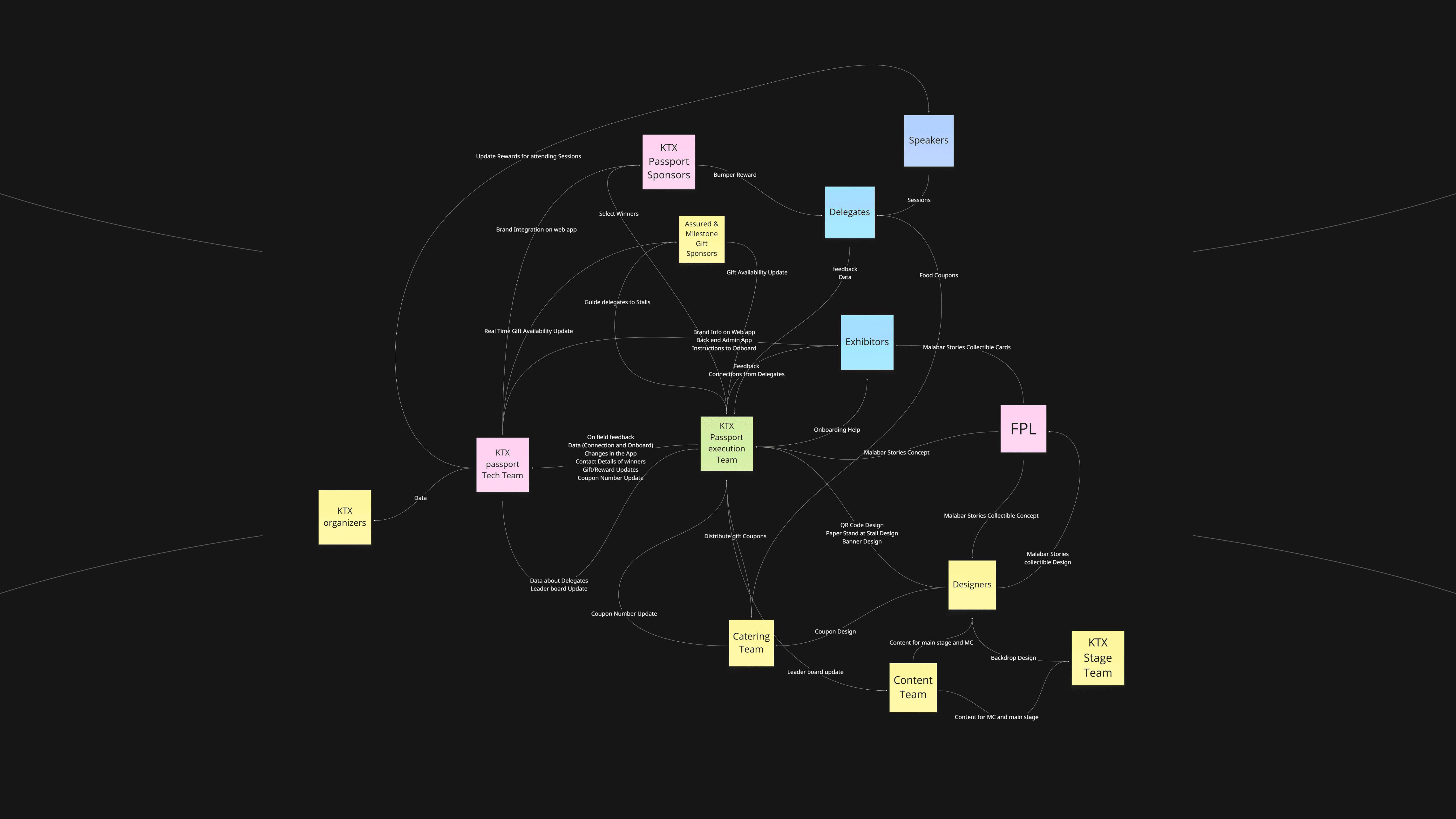
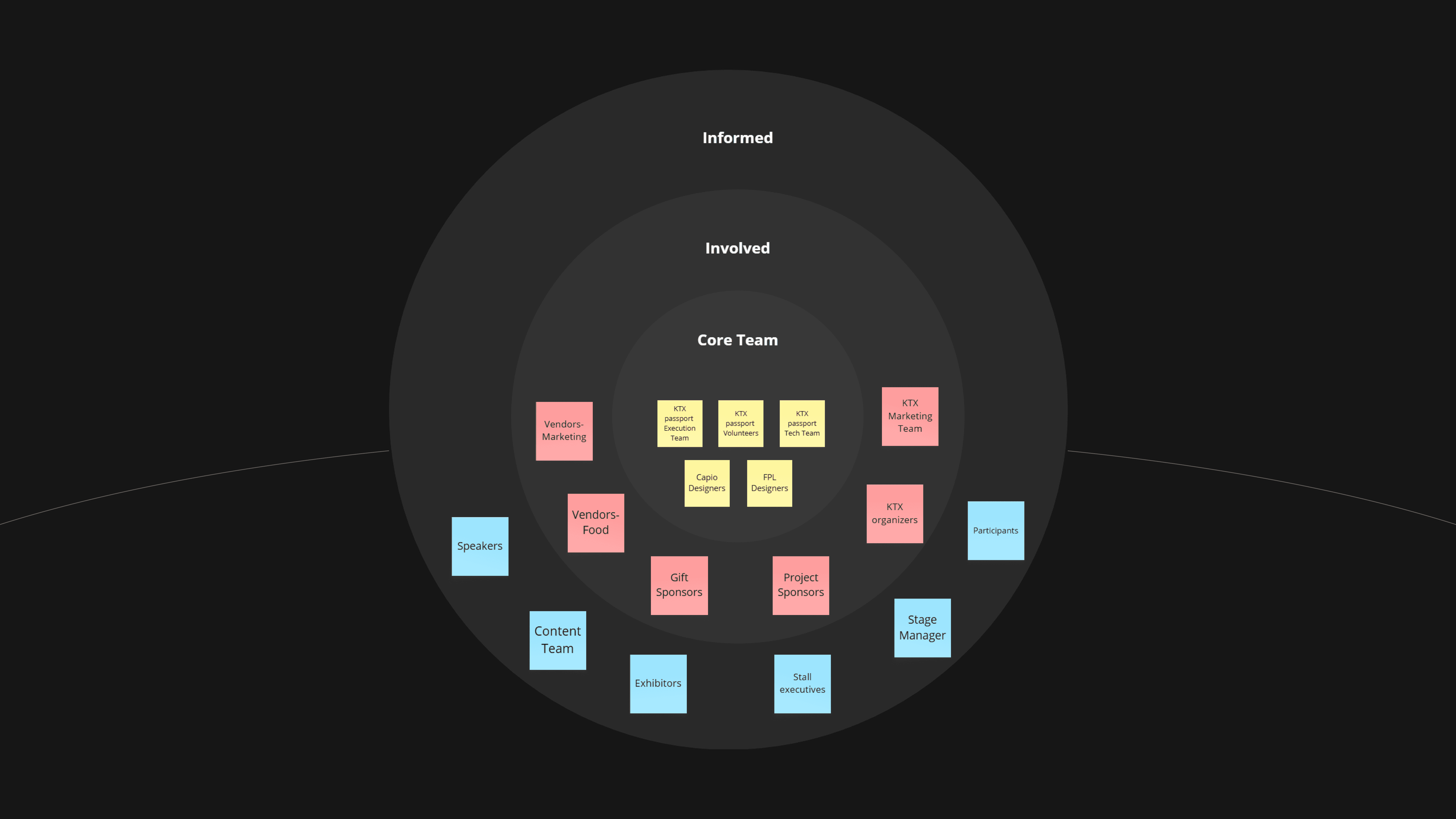
KTX Passport operates within a complex stakeholder web. Before the event, we mapped every stakeholder connected to the product and their relationships to each other: delegates, exhibitors, sponsors, the KTX organizers, the execution team, catering, content teams, stage management, designers, and the tech team. This map became the operational backbone for coordinating during the event.
Phase 2: During KTX
Two agendas running in parallel
During the event, the work split into two simultaneous agendas: deployment and user research. These weren't sequential. They happened at the same time, by the same team, across the same floor.
Deployment
Deployment meant enabling the volunteer team to onboard delegates, running product testing in real time, making UX iterations after each day, tweaking the reward structure in response to stakeholder behavior, and managing the operations of a 1,750-person onboarding across three days. Each evening, the team reviewed what was working and what needed to change before the next morning's opening.

User research
The research ran through three methods. Fly-on-the-wall observation captured how delegates actually moved through the venue and interacted with the product without any prompting. Data from the volunteer team's point-of-contact interactions surfaced the most common friction points in real time. Participative design brought delegates and exhibitors into brief conversations about what they needed from the product that the current version wasn't giving them.
What made this structurally interesting is that deployment and research were kept as intentionally separate intentions even though they happened in the same space, by the same team. The deployment team's job was to make the product work for users. The researcher's job was to watch what happened when it did and when it didn't. Keeping those intentions distinct, rather than collapsing them into a single role, is what gave the research its integrity. The presence on the floor was unavoidable. The separation of what each person was there to do was a deliberate choice.
That intentional separation also gave the research characteristics of participatory design: users weren't just being observed, they were actively contributing to the product's direction through the conversations that happened naturally at onboarding, at stalls, and during support interactions. The line between user and co-designer blurred in a way that wouldn't have happened in a more controlled research setting.
Deploying and researching in the same space aren't in conflict if you keep the intentions distinct. The deployment creates the conditions. The research reads what those conditions produce.
Phase 3: After KTX
From field data to design direction
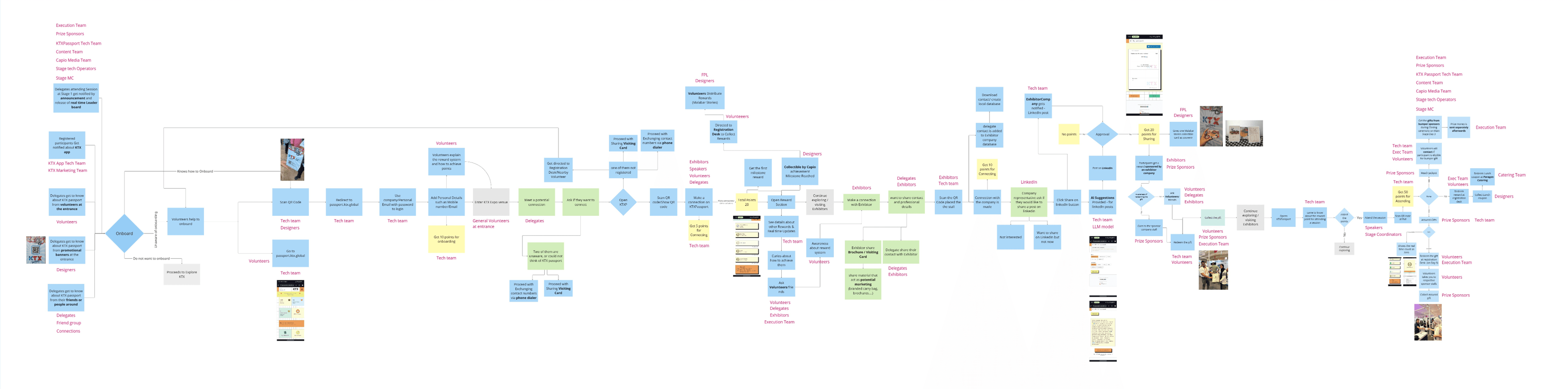
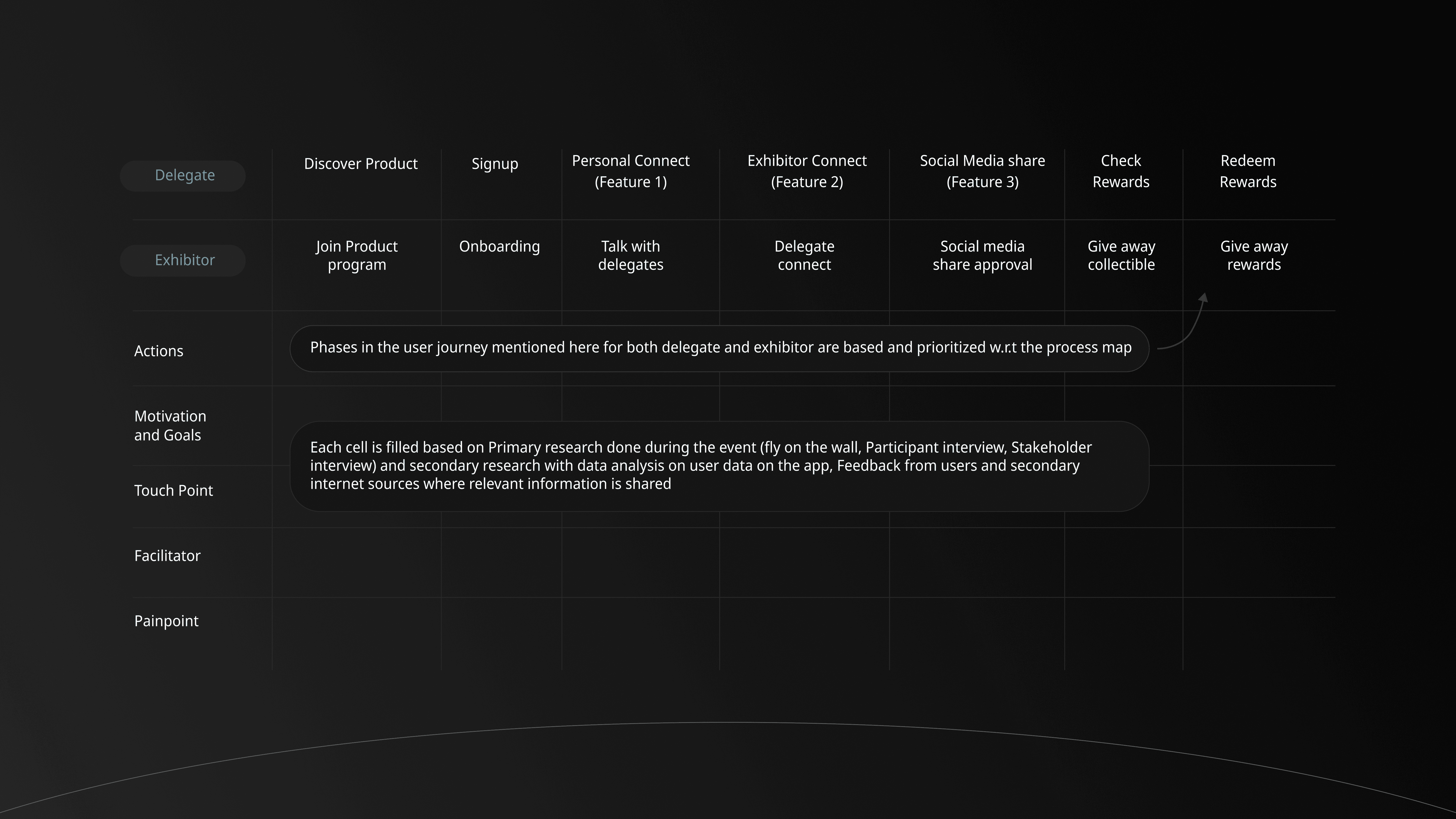
After the event, the work shifted to consolidating what three days of live research had produced. The primary output of this phase was a process map: an end-to-end mapping of every product touchpoint during the event, connected to the stakeholders present at each stage. This was not a retrospective diagram. It was a tool for identifying exactly where the product needed to evolve.
User journey
The user journey was reconstructed from primary research: fly-on-the-wall observations, participant interviews, stakeholder interviews, and user data from the app. It covered both delegate and exhibitor journeys, with each cell filled based on what was actually observed rather than what was assumed at the design stage.
Prioritization
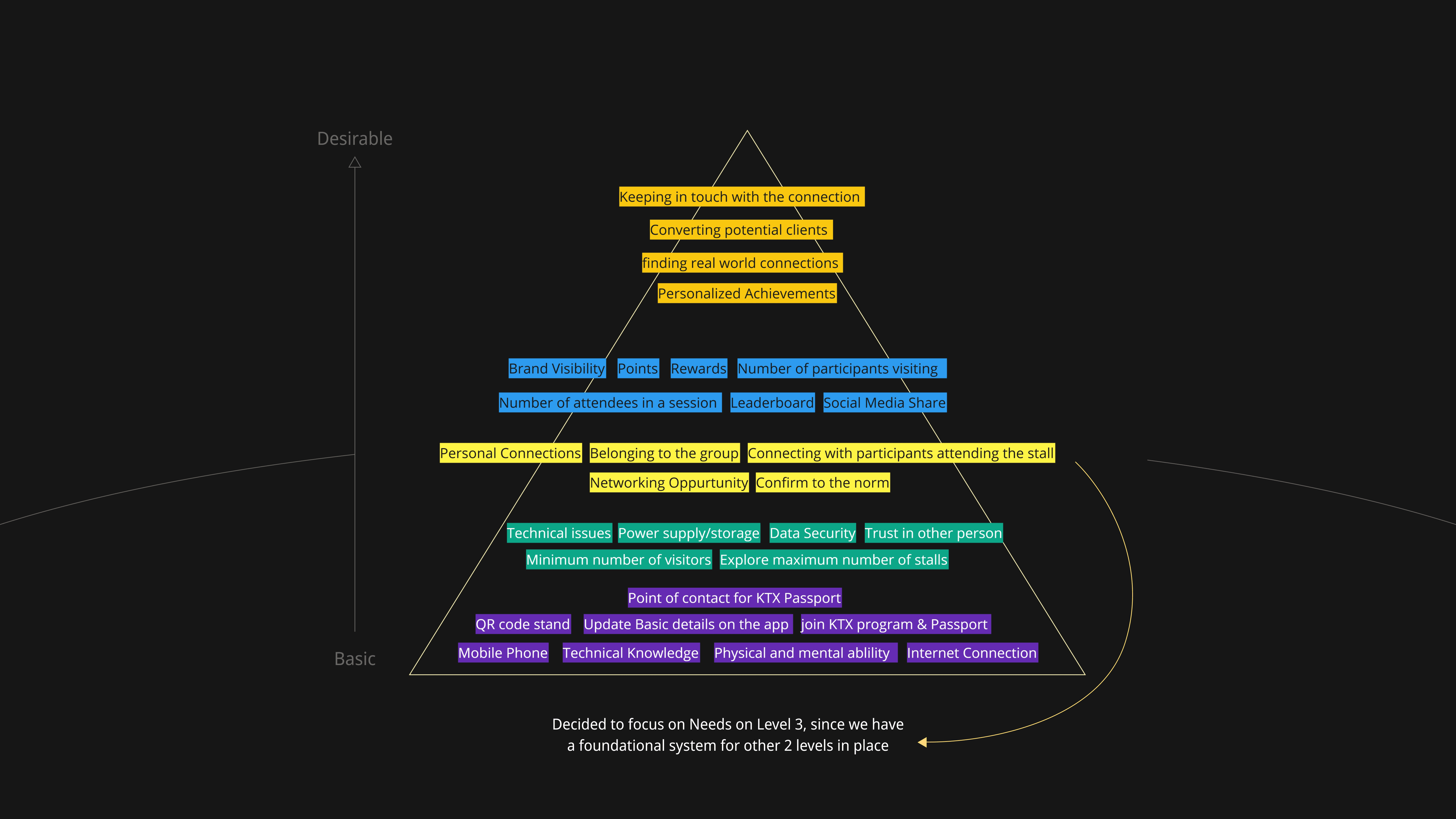
With a significant number of pain points identified, the team needed a principled way to decide what to work on first. KTX Passport V1 was a first version. The decision was to solve for the most basic unmet needs before addressing desirable enhancements.
We built a modified hierarchy (tailor-made for the research context) to place identified opportunities and challenges across three levels: Basic, Intermediate, and Desirable. We focused on Level 3 needs, specifically those around personal connection, belonging, and social confirmation, because the product already had a functional foundation for Levels 1 and 2.
The target group
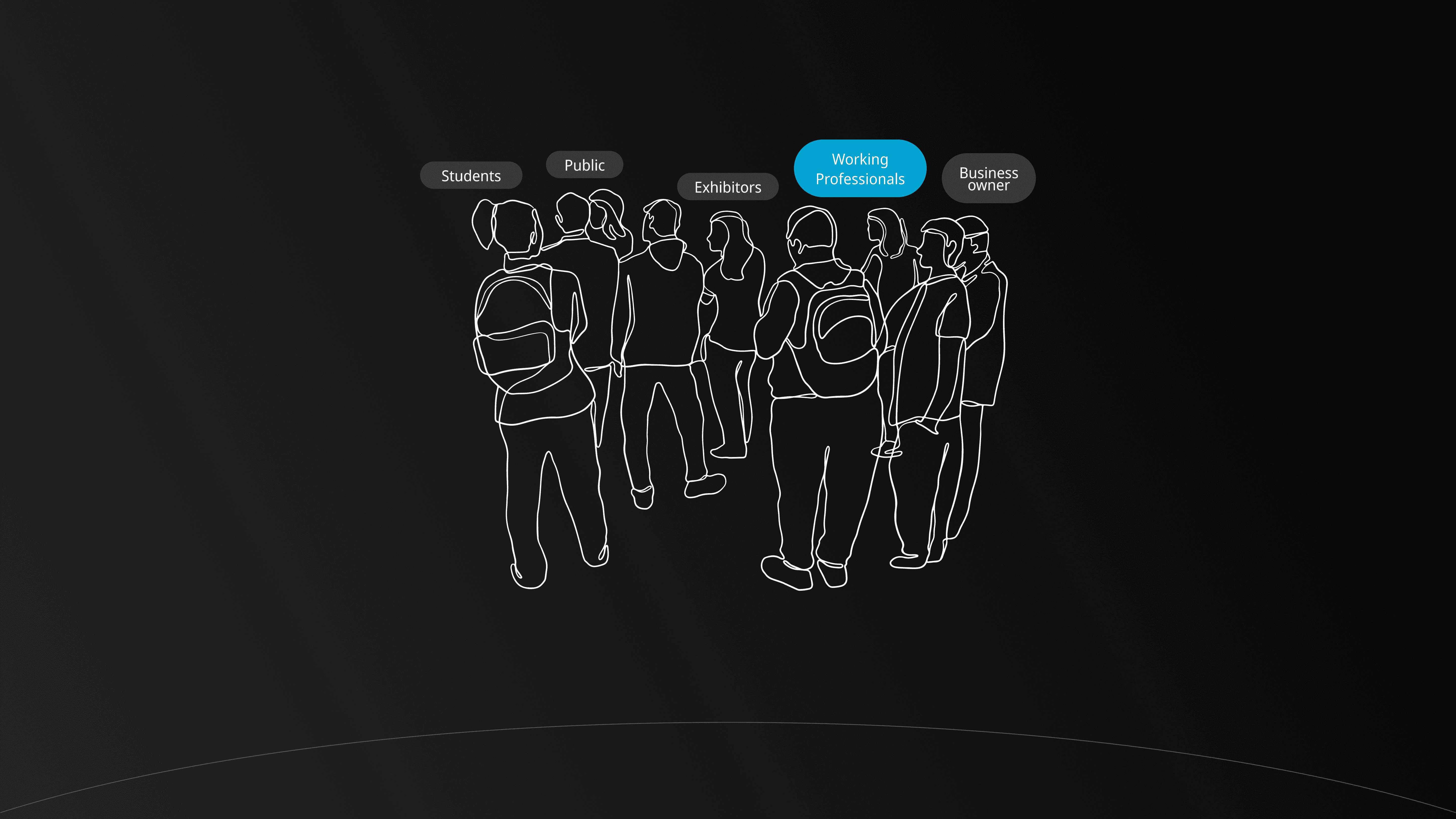
Within the delegate population (business owners, working professionals, students, general public), research identified working professionals as the highest-value group to focus on. They aligned most closely with the event's goals, with exhibitor interests, and with the opportunity areas identified in the user journey. They were also the group most likely to derive ongoing value from the product beyond the event itself.
Design Brief
Make KTX Passport relevant for working professionals at KTX
The brief that emerged from the research was deliberately simple. Relevance for working professionals meant addressing what V1 didn't provide: a reason to stay engaged between connections, and a way to meet people with shared professional interests rather than simply meeting anyone nearby. The output of this phase is V1.2 — a proposed design, not a deployed one. The insights from the live event are what made it possible to define the brief with this precision.
The solution phase used four frameworks in sequence. The COM-B framework explored user needs and the barriers to those needs being met. Affinity mapping consolidated the opportunity areas from research. Brainstorming generated feature and flow ideas. The EAST framework (Easy, Attractive, Social, Timely) tested each proposed feature for compatibility with the product and the brief.
The research didn't produce a long list of problems to solve. It produced a short list of the right problems, in the right order.
The sequence matters: observe first, identify the pattern, then reach for the behavioral science principle that names what you found. Reversing that order produces design that looks rigorous but isn't grounded.
Design Intervention 1
Engaging users between connections
The first intervention addresses a specific gap identified in V1: once a delegate made a few connections, there was no compelling reason to keep opening the app. Retention dropped after initial onboarding. The product had no ongoing content layer.
What V1.2 proposes
Two additions to the home screen. First, an Exhibitor Feed: exhibitors can share short posts about what is happening at their stall in real time. A product demonstration about to start. A speaker visiting the stall. A limited giveaway. This gave delegates a reason to check the app throughout the day, not just at the moment of connection.
Second, an Event Updates section: real-time information about what was happening across the venue, session timings, and coming-up notifications. Delegates no longer had to find a physical notice board or ask a volunteer. The information came to them.
Retention isn't solved by adding more features. It's solved by making the product useful at more moments in the day.

Design Intervention 2
Community building through shared identity
The second and more significant proposal addresses the deeper insight from the research: the barrier to networking at events is not the absence of people. It is not knowing how to start a conversation with a stranger. The research found, consistently, that working professionals felt most comfortable in groups defined by shared professional identity. V1 had no mechanism for this.
What V1.2 proposes
A Communities feature within the KTX Network tab. Delegates could discover and join communities organized by profession (Interaction Designers of KTX, Product Designers of KTX, and so on). Joining a community earned KTX Coins, which embedded the behavior in the existing reward structure.
Within each community, exhibitors could post about mini events at their stalls, targeted at specific professional groups. A design firm hosting a portfolio review session. A tech company running a product demo for engineers. These posts appear in the community feed, giving professionals a specific, low-stakes reason to walk to a stall.


Outcomes
What happened in three days
KTX Passport V1 was deployed across all three days of the event. The numbers came from a product that was being iterated every evening based on what the previous day had shown.
The V1.2 interventions were designed based on patterns that only became visible by being present at the event. The proposed features were not deployed during KTX. They are the design output of the research, intended for the next version of the product. The venue map, the stakeholder ecosystem, the user journey, the modified needs hierarchy. These were produced during and immediately after the deployment, not before it. The research method and the product method were the same method.
Interventions were tailor-made for KTX Global. Owing to the fundamental nature of the improvements proposed, the product is scalable to similar environments and scenarios.
Reflection
What this project taught me
What worked
Running research and deployment simultaneously, in the same venue, with the same team, produced insights that a sequential research-then-design process would have missed entirely. The evening iteration cycle (observe in the day, change by morning) is something I hadn't done before and won't forget. The product that existed on Day 3 was meaningfully different from the one that launched on Day 1, because we were willing to change it while it was live.
What I'd do differently
The volunteer team was both the deployment layer and the primary data collection layer. That's too much to ask of one group. In a future deployment, I'd separate the two roles more clearly: people whose job is to help users, and people whose job is to watch users. The quality of observational data suffers when the observer is also the helper.
What I'm carrying forward
The modified needs hierarchy was the most useful analytical tool in this project. Adapting Maslow's structure to the specific context (event, not life) gave us a principled basis for prioritization that the team could align on quickly. I'll take that approach into future research contexts: don't use a generic framework, build one that fits the problem.