Service Design · Academic · NID Interaction Design
Tachh
Graced by the Skilled
A service enabling Kerala's woodworking professionals
to be creative during their off season
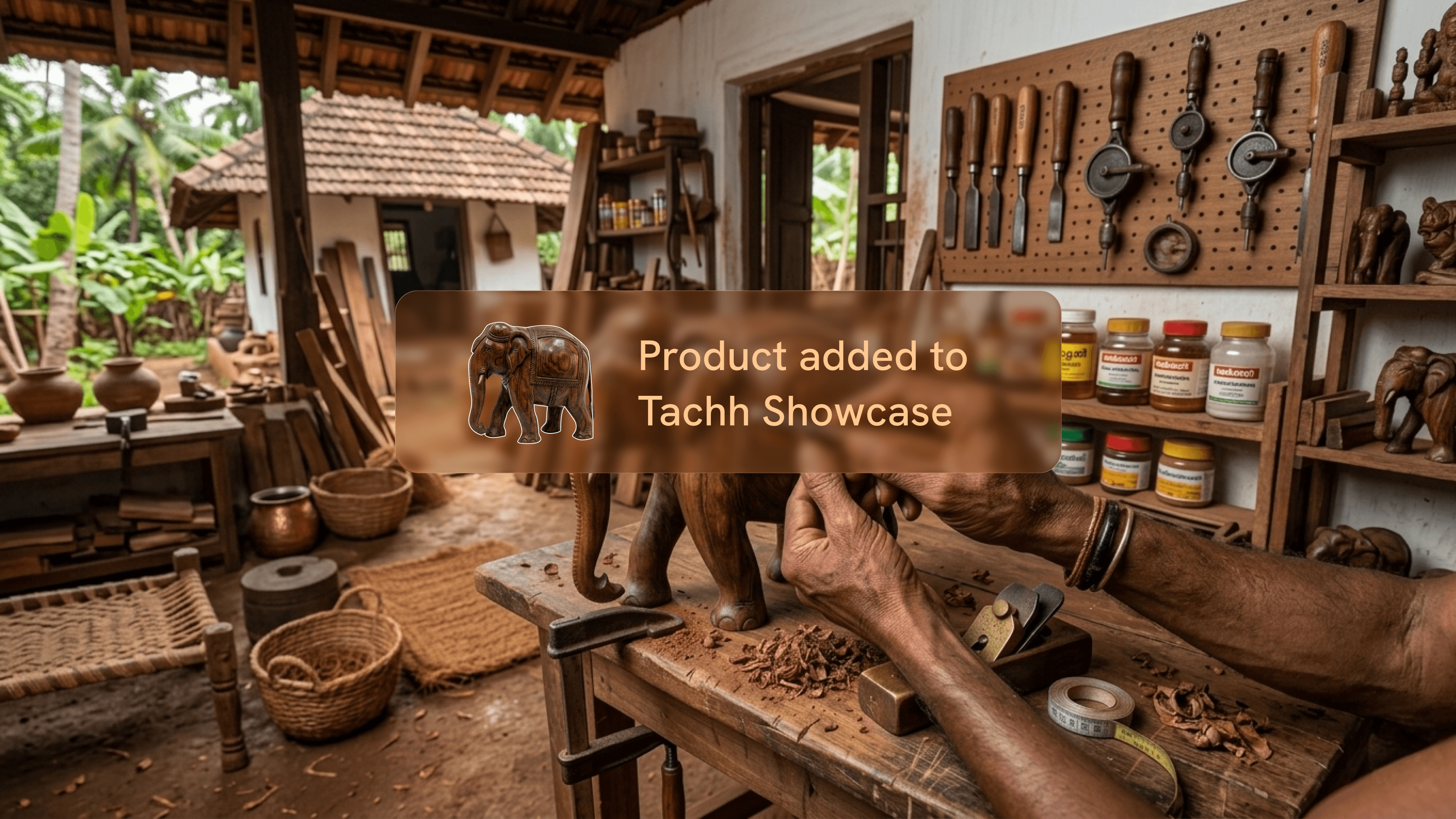
The Problem
The problem no one had connected
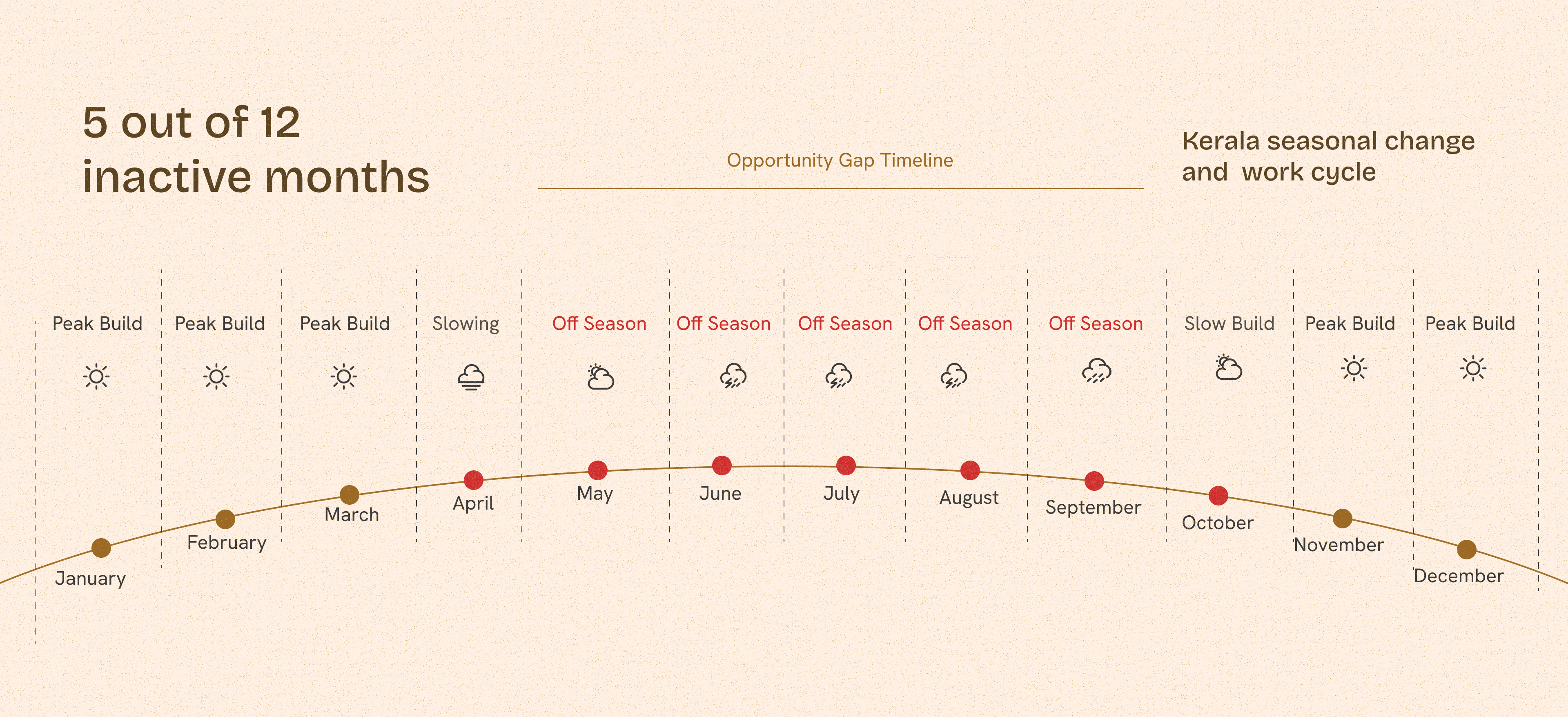
Kerala is home to tens of thousands of master woodworkers. Their workshops produce furniture, decorative objects, and bespoke pieces that internationally trained designers would pay to collaborate on. And yet, for five months every year (May through September), those workshops fall silent.
Not because the demand disappears. Because nobody had thought to connect the two during the gap. The problem isn't a skills shortage. The problem isn't a market shortage. The problem is that both exist in the same geography, on different timelines, without a bridge between them.
"What if the best time to build a business is the one everyone else ignores?"
The off season (the window that looks like a void from the outside) is actually the most fertile window for a service intervention. Demand hasn't gone away. The producer is available, unbooked, and carrying skills that have never found an off-peak market.
Service Promise
The carpenter is the primary user, not a supplier
This single line governed every design decision in Tachh. Most craft platforms position the artisan as a production node: a means to deliver goods to a consumer. Tachh inverts this. The carpenter is the person the service was designed for first. The consumer side of the marketplace is real, and commercially essential, but it is secondary to a service that genuinely works for the producer.
This inversion has consequences. It changes how trust is built. It changes what presence looks like. It changes the tone of the digital interface, the design of the physical showcase, and the criteria against which every feature gets evaluated.
Five service attributes
These five attributes don't operate independently. They form a logic chain. Trust makes onboarding possible. Presence makes retention possible. Growth and Showcase together make the value proposition visible to producers. Relevance makes the service sustainable beyond a single season.
Project Scope
Three functions, one off season
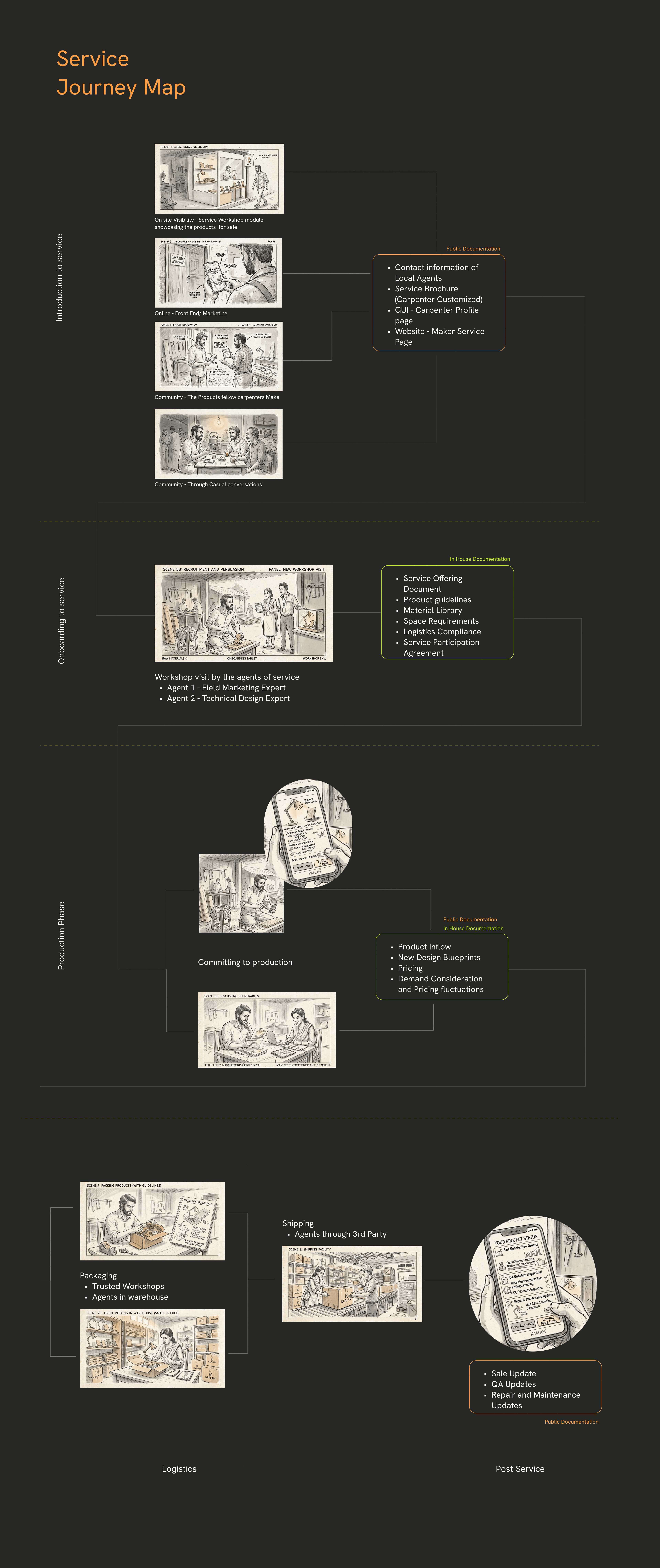
Tachh operates primarily during the five break months: May through September. Within that window, the service delivers three distinct functions to the carpenter: Showcase, Get Hired, and Create. Each function has its own touchpoints, its own interface layer, and its own logic. Together they form a complete off-season offering.
The diagram maps the full index of service touchpoints across all three functions. GUI touchpoints are screen-based interactions. IoT touchpoints connect the physical showcase unit to the digital platform. Product touchpoints are physical objects or processes the service introduces to the carpenter's workflow.
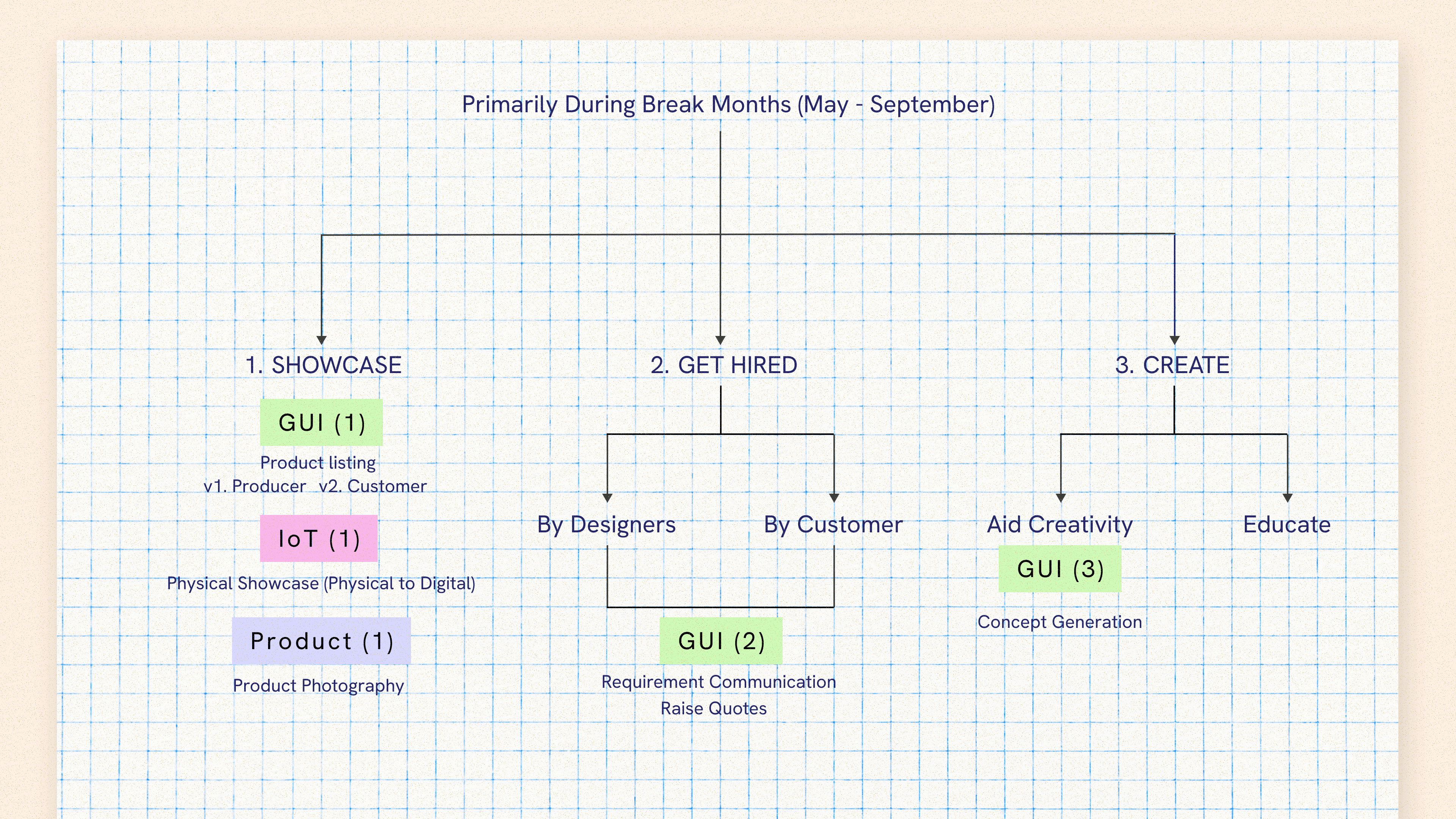
The three functions are designed to be independent but complementary. A carpenter can engage with Showcase only and still derive value. Engagement across all three compounds over the course of a season. The scope was kept deliberately contained. Breadth was sacrificed for depth at each touchpoint.
Function 1
Showcase: making the workshop visible
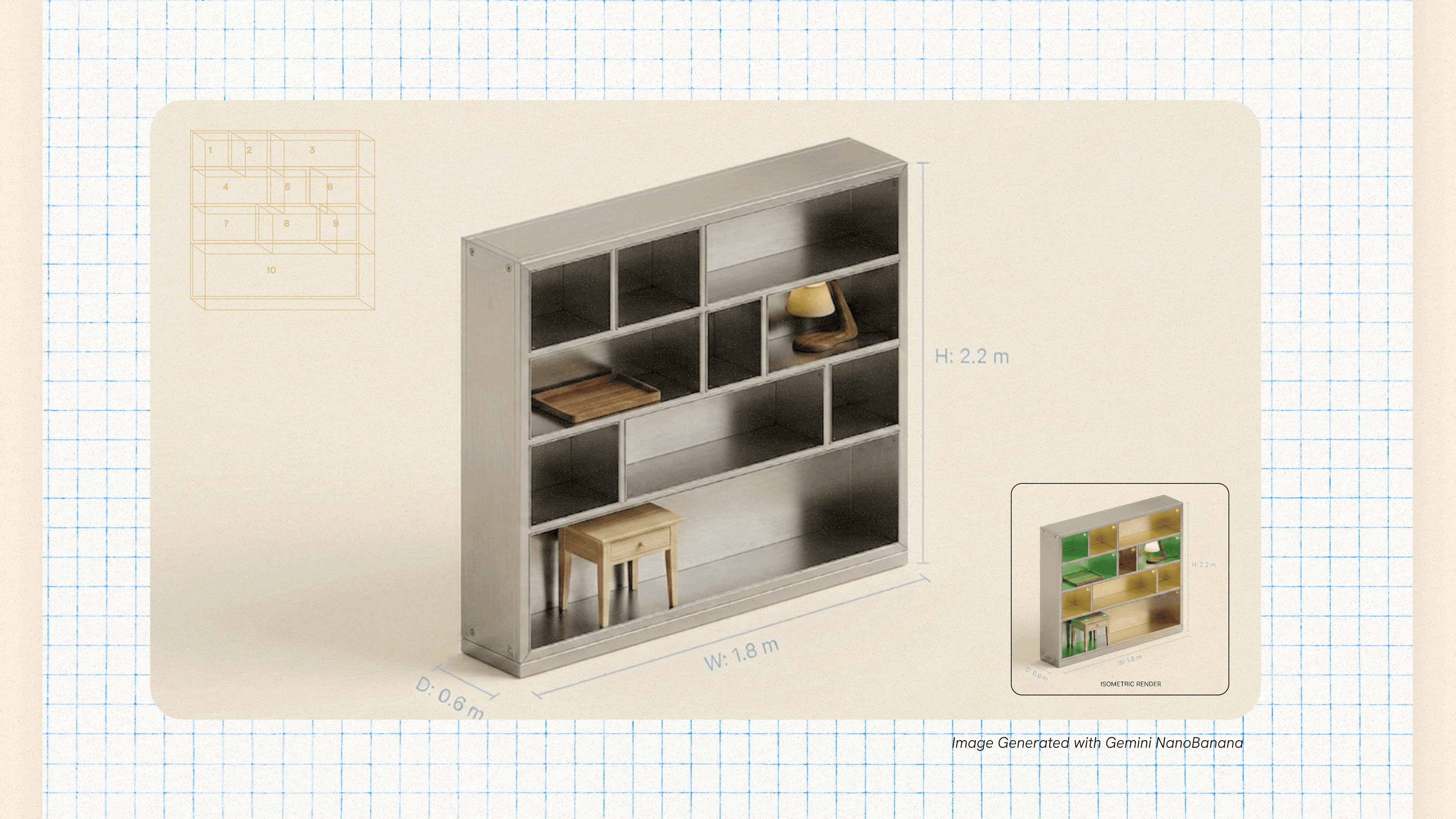
The physical showcase is a 2.2m × 1.8m × 0.6m unit installed in the workshop itself. It gives each producer 10 slots (6 small-scale, 3 medium, 1 large) to display products to the physical space. This is not a display window for customers who walk in. It is a staging environment: the products placed in the showcase are photographed, digitised, and surfaced on the platform.
The showcase serves a function beyond storage. It anchors the service physically in the workshop, making the platform's presence tangible, recurring, and impossible to forget.
How showcase slots are determined
Not every workshop receives an identical showcase configuration. Two field agents conduct an in-person assessment: one technical, one with a marketing background, before installation. The technical agent evaluates machinery, tooling capacity, and demonstrated skill range. The marketing agent assesses product vocabulary, aesthetic sensibility, and potential market positioning.
"The showcase doesn't arrive as a fixed product. It arrives sized to the workshop. That sizing is a judgement call, made by people on the ground, who understand both what the carpenter can make and what the market wants."
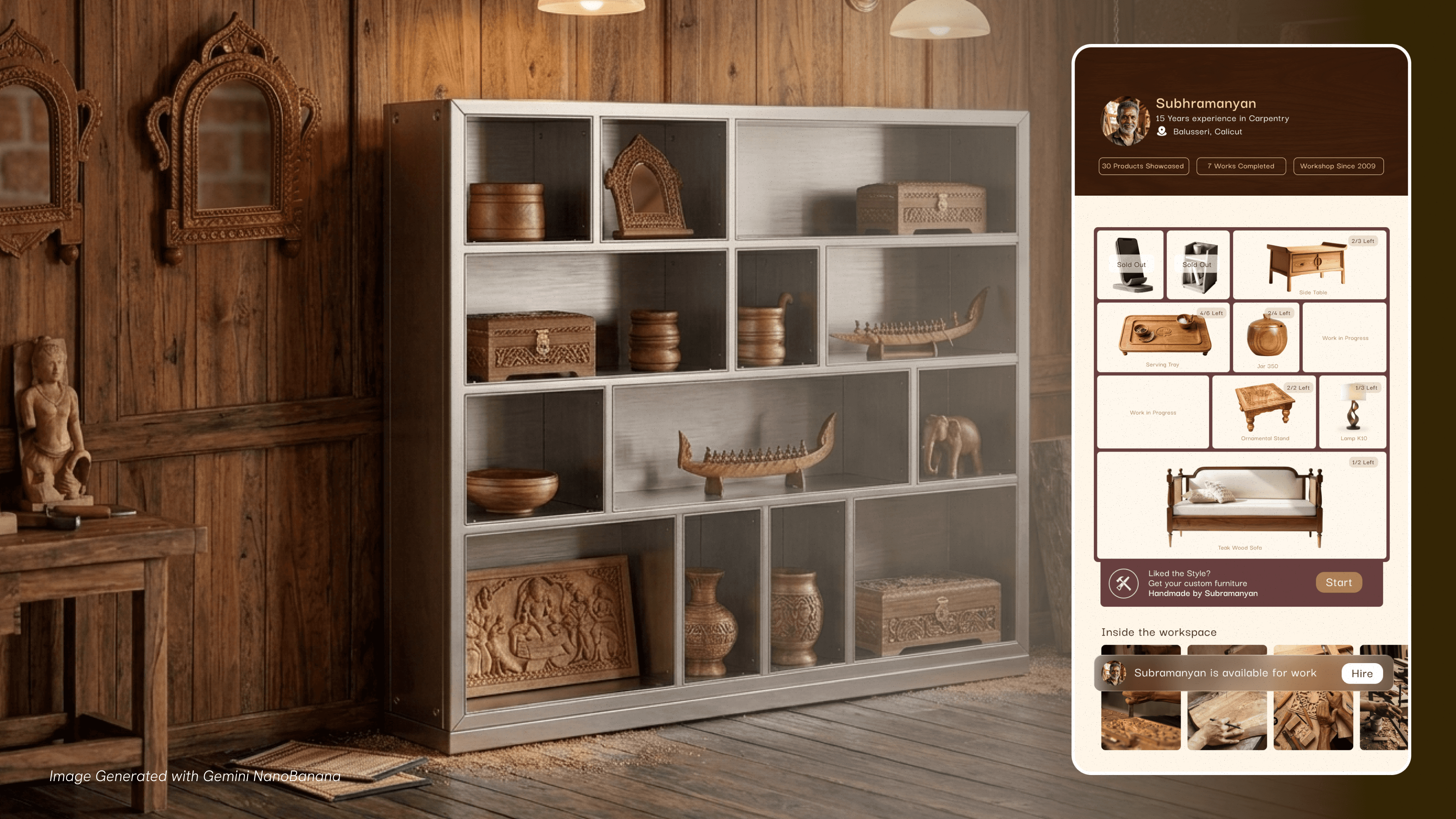
Producer listing interface
The producer listing screen shows a carpenter's total showcase value and past sales, giving a clear economic picture of what the showcase is currently worth. Products can be added either as personal listings or as demand-responsive productions: items the service recommends making based on what the market is asking for.
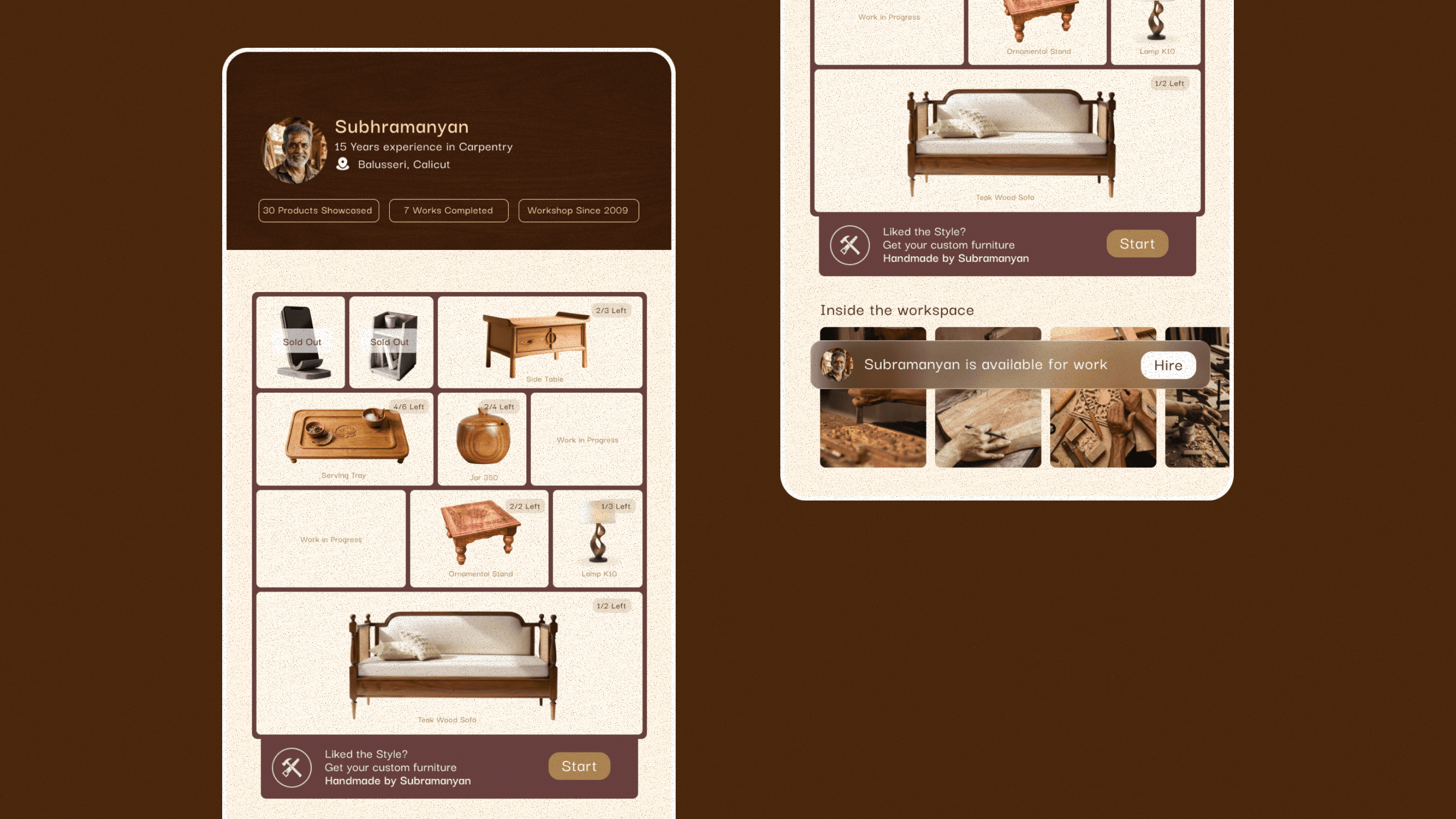
Assistive camera
Product photography is a known bottleneck in craft platforms. The quality of product images directly affects commercial outcome. Most carpenters have never had to think about this before. The Assistive Camera provides real-time framing feedback (directional prompts like 'Move the camera to your right'), reducing the skill gap without requiring training.
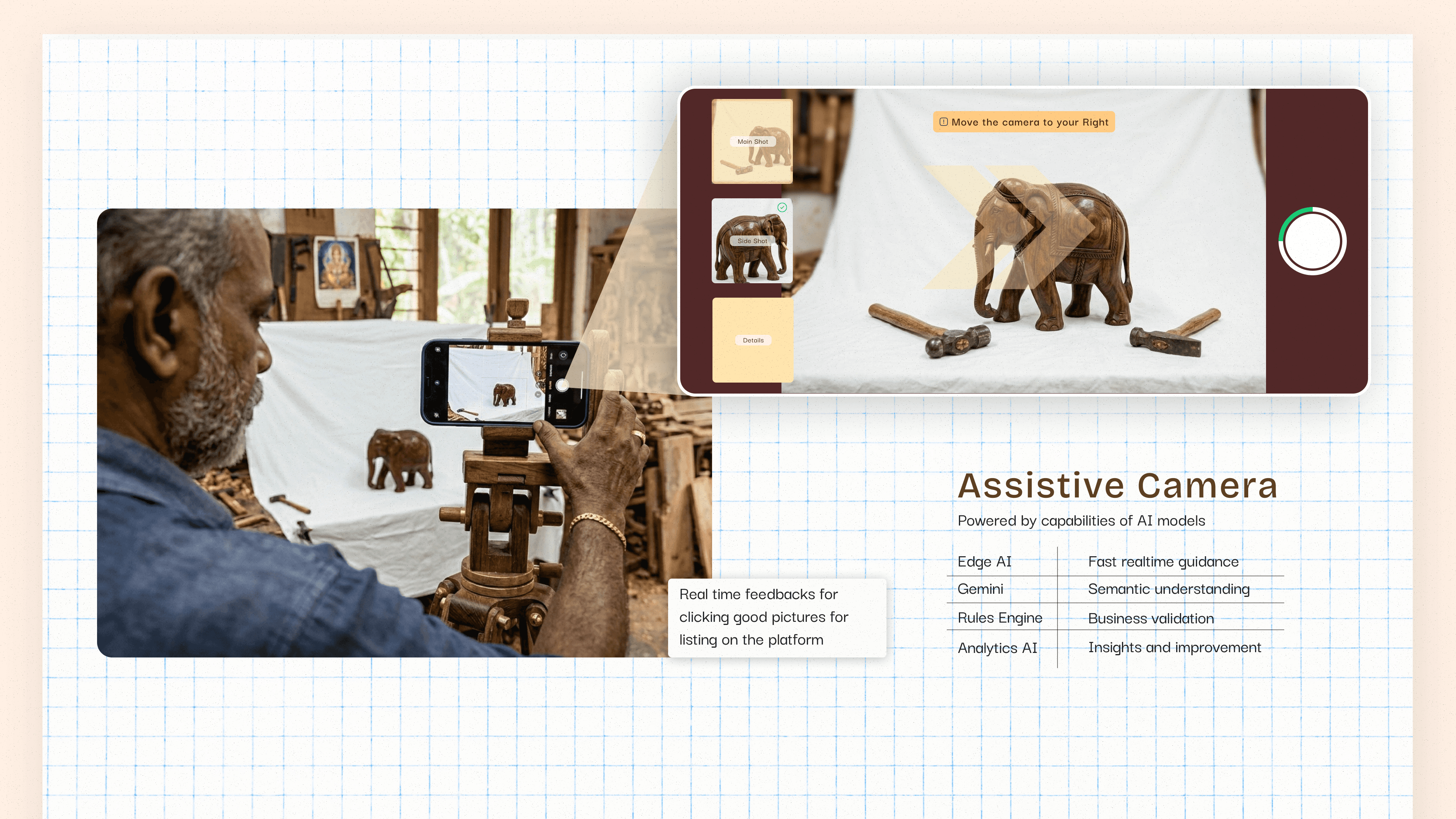
Price assist
Carpenters tend to undervalue their work significantly, partly from habit and partly from lack of market visibility. The Price Assist feature shows a recommended earnings range based on wood type, product category, and current market data, with a 'Sale Chance' indicator that signals how likely a given price point is to convert. The carpenter sets the price. Price Assist gives them the context to do so with market awareness rather than habit.
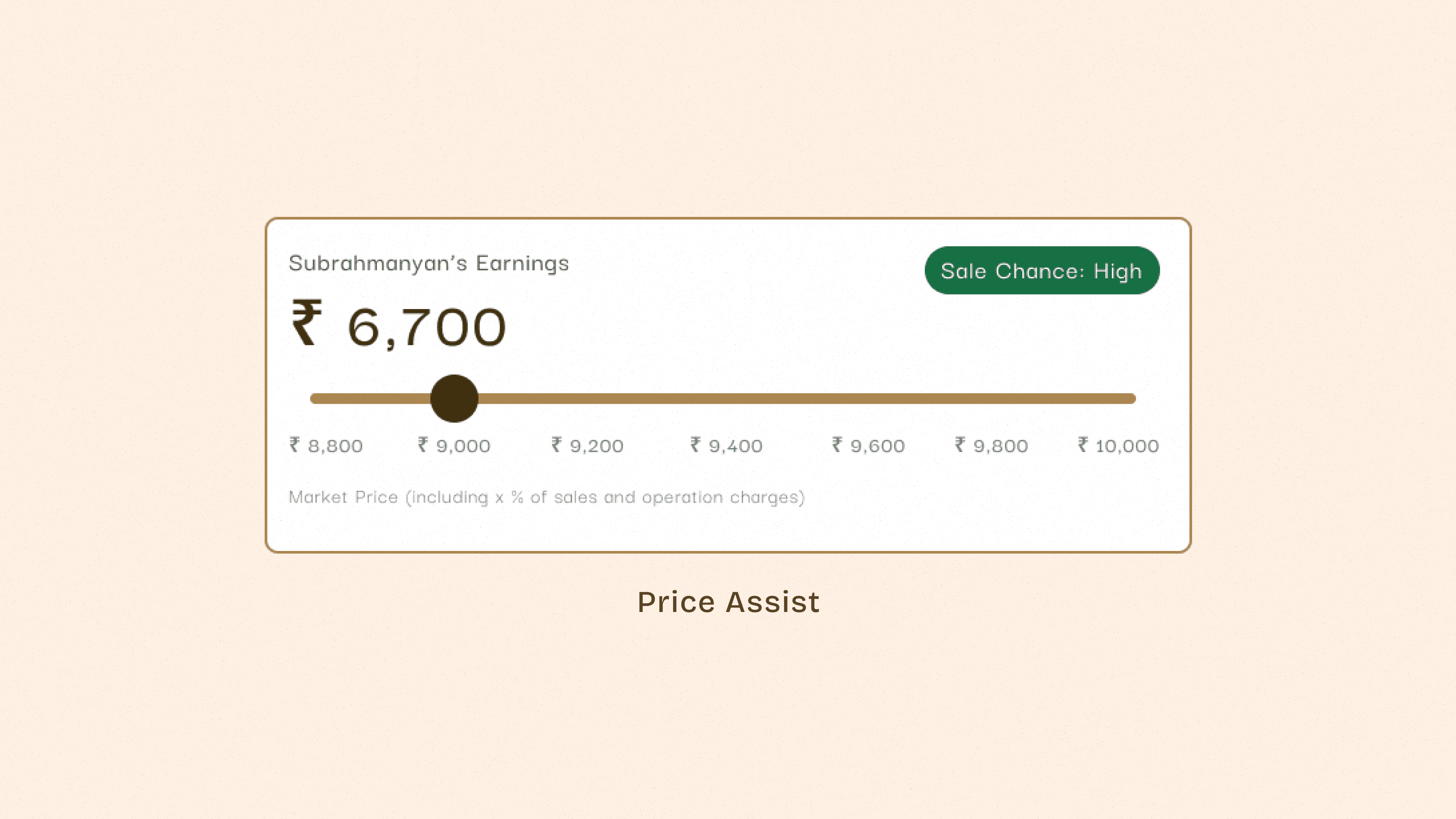
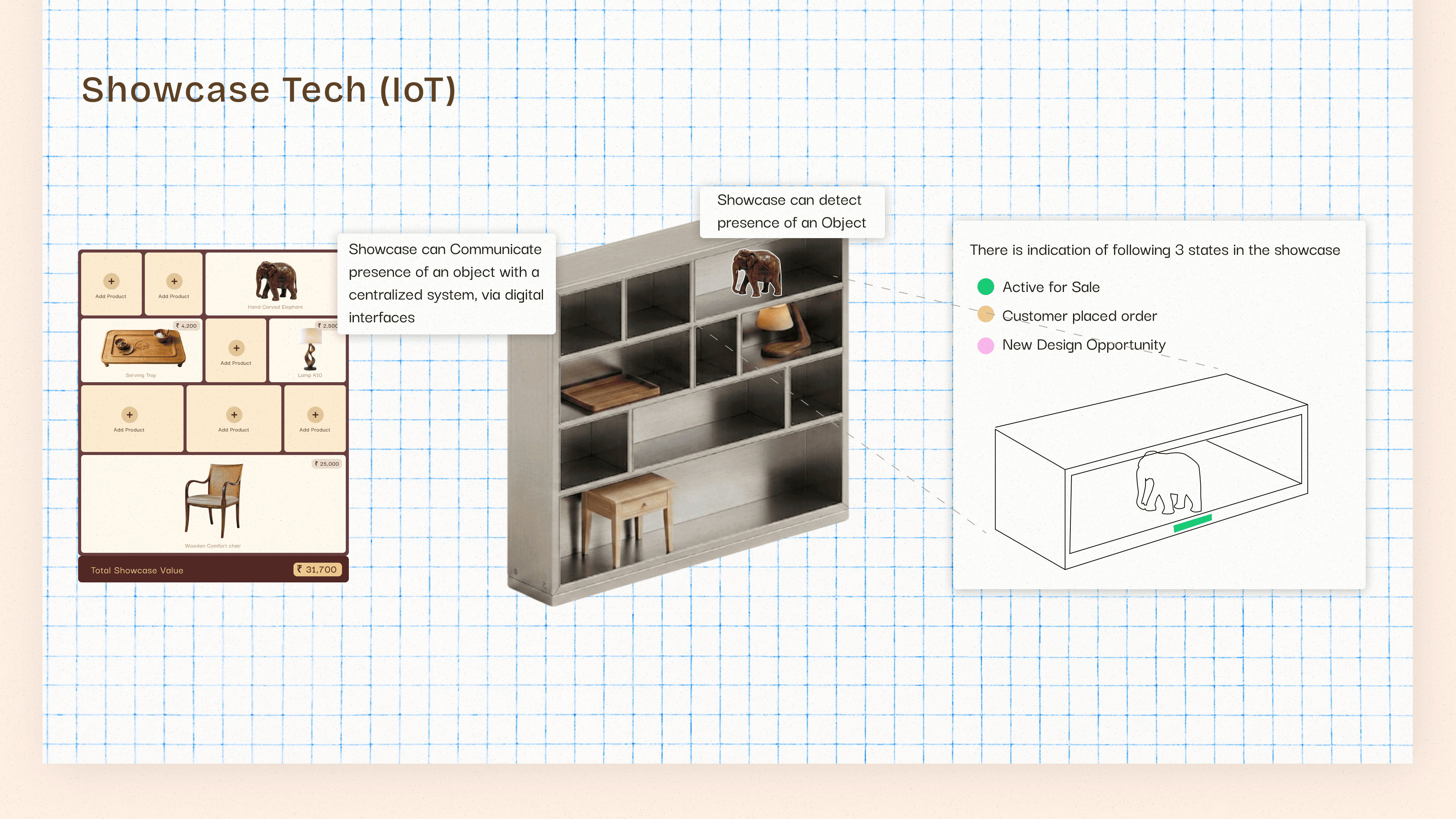
IoT integration: three slot states
Once a product is listed, the carpenter places it in a physical slot in the showcase unit. The app confirms the placement. The digital and physical inventories are now linked. Each slot can detect the presence of an object. When a customer places an order, the platform flags that slot. When the service identifies a design opportunity, it illuminates the relevant slot to signal the producer.
Service journey map
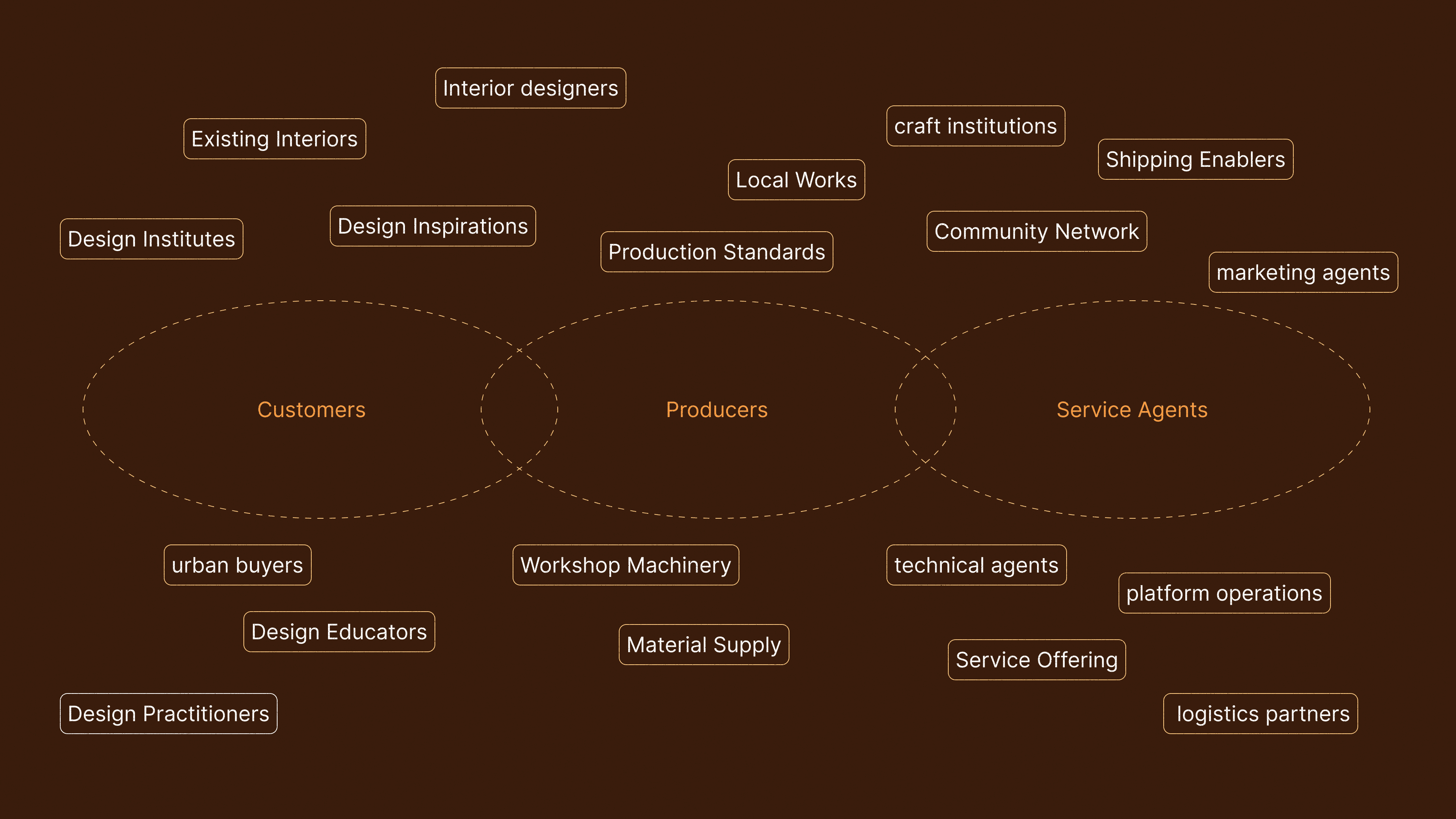
Stakeholder ecosystem
The stakeholder ecosystem positions Tachh at the intersection of four groups: producers (carpenters and workshop owners), consumers (urban buyers, interior designers, design professionals), the service's own field layer (technical agents, marketing agents, platform operations), and the broader enabling ecosystem (timber suppliers, logistics partners, craft institutions, and design schools).
Function 2
Get hired: two routes to work
Tachh connects carpenters to paid work through two distinct channels, each suited to a different kind of demand.
Custom work: hired by the customer
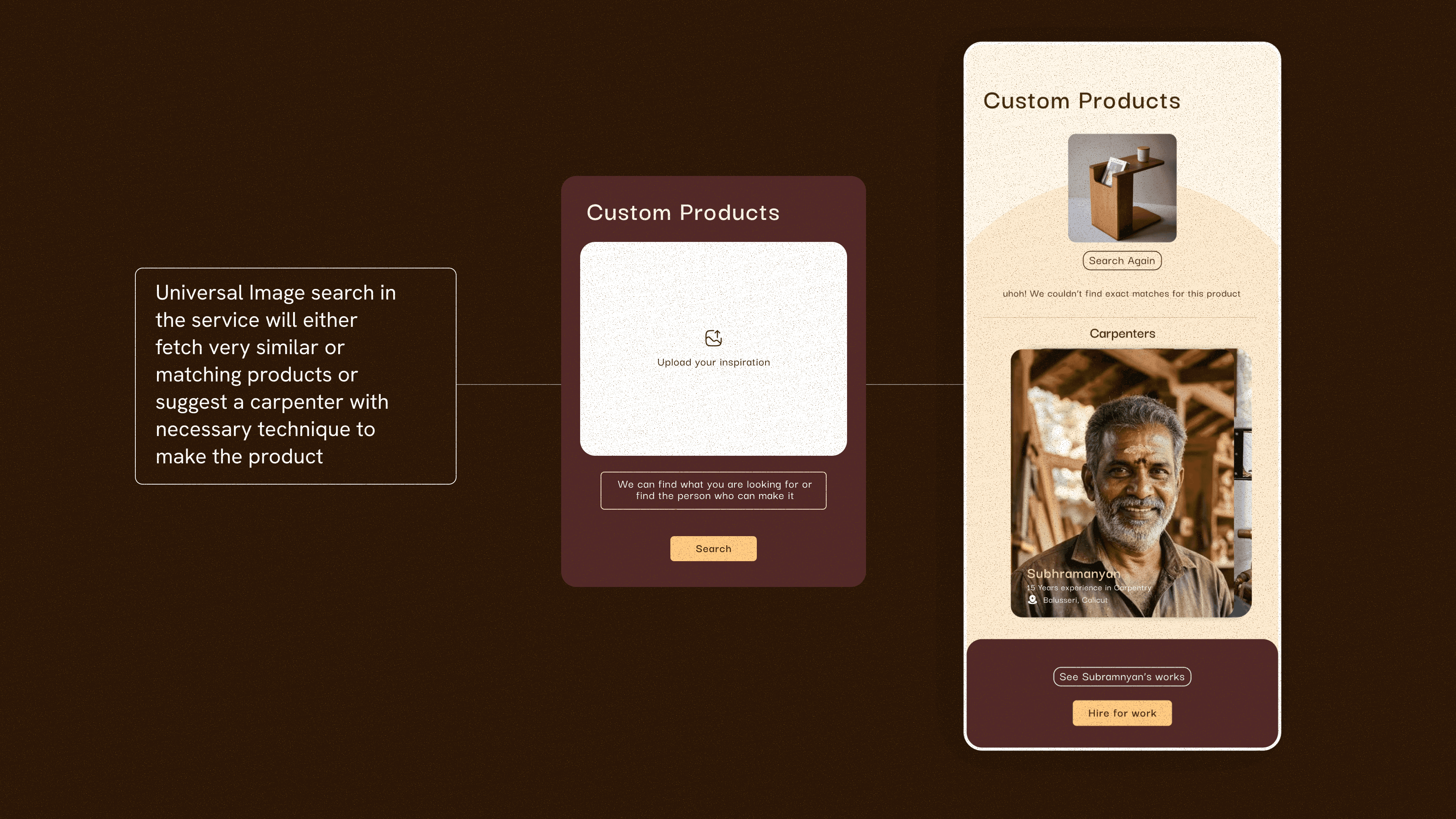
The consumer side of Tachh is built around the friction that currently makes custom wooden furniture inaccessible: the gap between what a customer can imagine and what they can communicate to a craftsperson. The service resolves this through an AI-assisted image search: a customer uploads inspiration imagery, and the platform either finds a matching product in the inventory or identifies a carpenter with the technique required to produce something close.
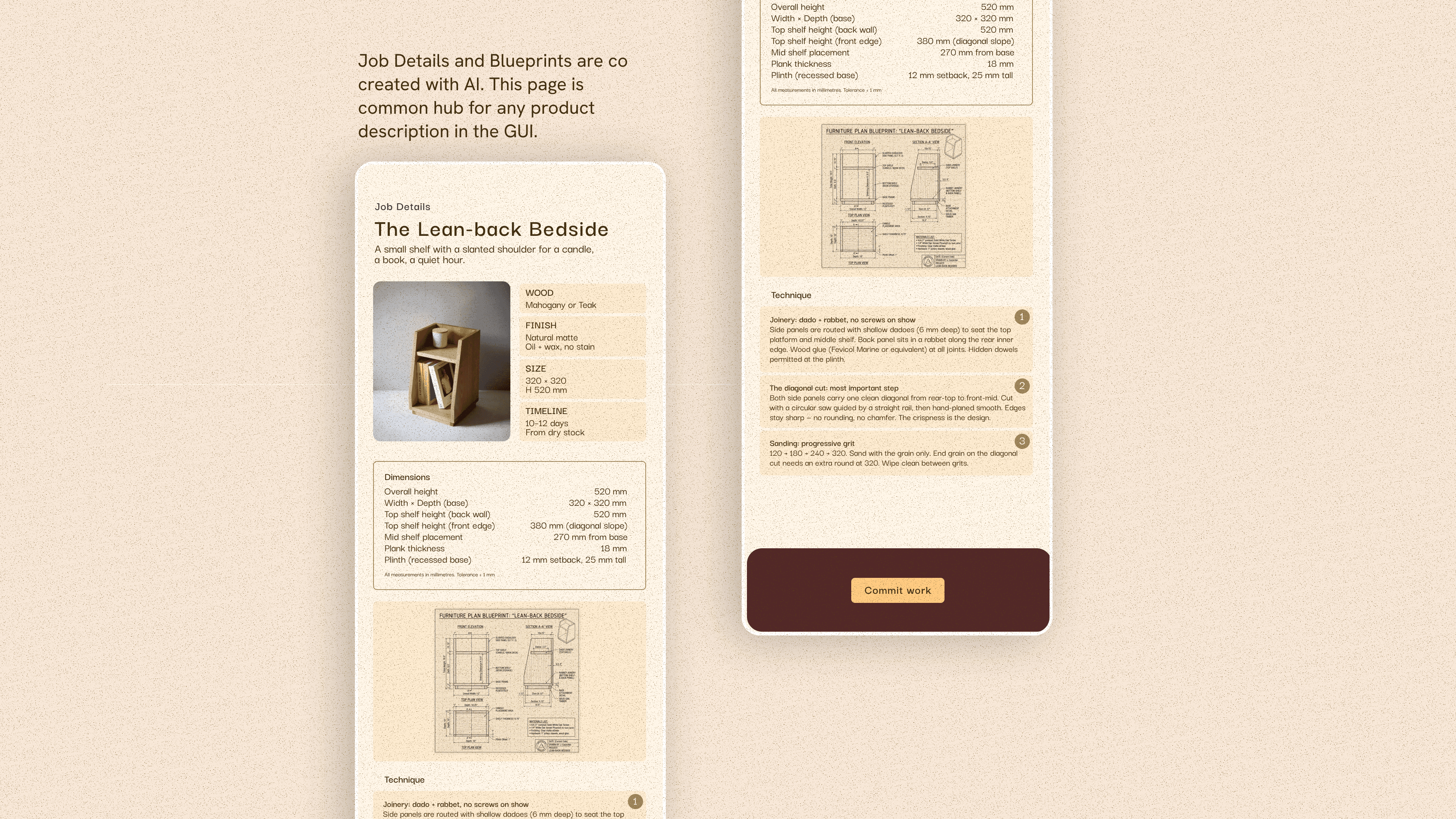
Job details: the common language
The Job Details page is not just a specification document. It is the interface where customer intent and carpenter capability meet, with AI as the translator between them. Wood type, finish, dimensions, timeline, and a technical blueprint are generated from the description and imagery provided. For the carpenter, this means receiving work with a clear brief, not a vague request that requires multiple rounds of clarification.
Design for market demand: hired by the service
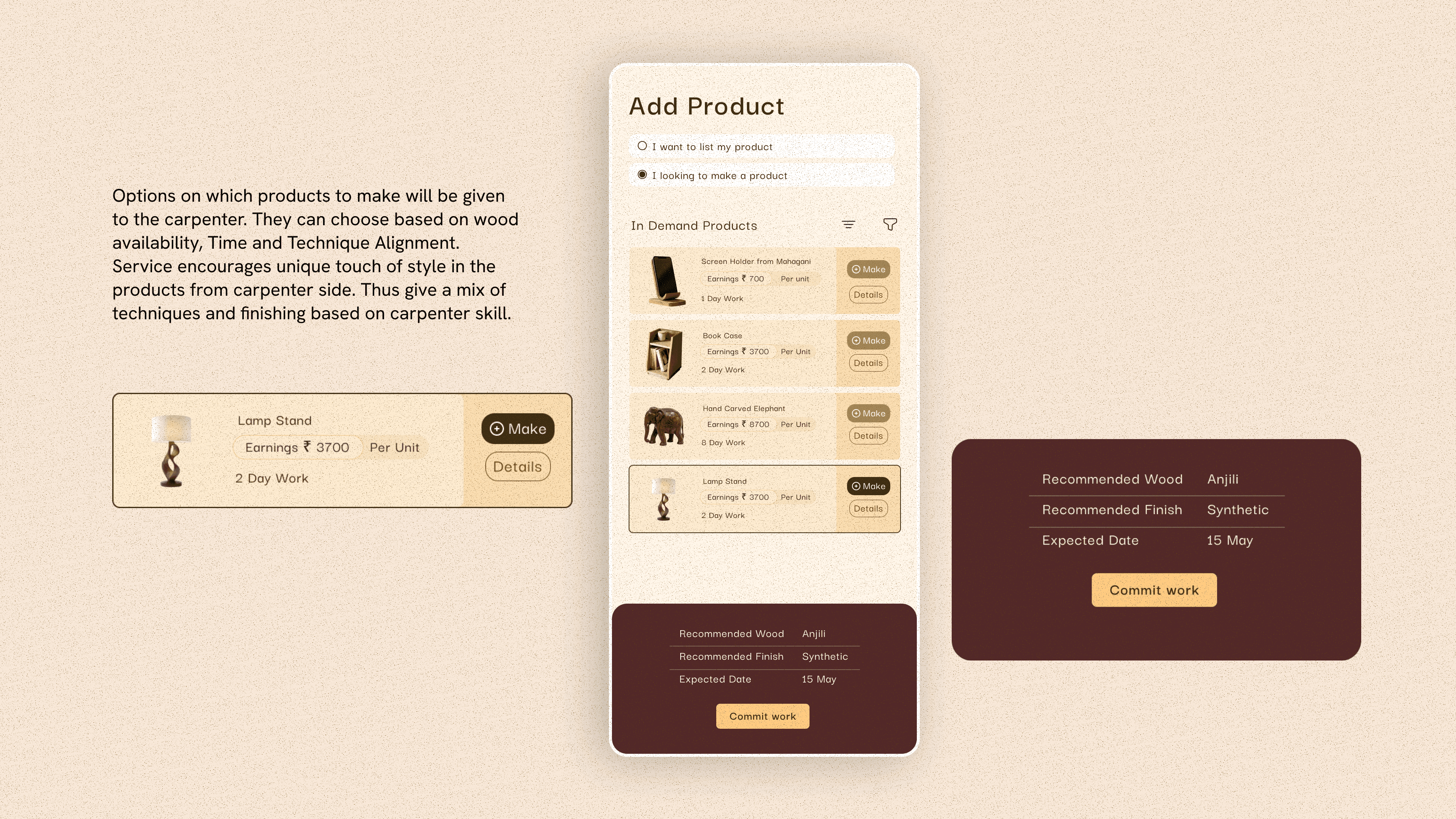
The second hiring route is service-curated. Based on what's selling, what's trending, and what inventory the platform needs, Tachh surfaces a list of in-demand products to carpenters during the off season. The design intent is specific: the service encourages each carpenter to add their own stylistic touch rather than producing exact copies. This creates a product catalogue with genuine variety: shared templates, individual authorship.
Function 3
Create: building creative confidence
The Create pillar addresses a challenge that sits underneath the commercial layer of Tachh: many carpenters haven't had space, during their working lives, to think about design independent of a client brief. The off season is the window where that can change.
Aid creativity
The Aid Creativity tool uses generative prompting to help producers explore product directions, suggesting material combinations, presenting reference imagery from adjacent design traditions, or asking generative questions about a partially-formed idea. This is not a product design AI. It does not output blueprints or finalised concepts. It is a conversation partner for a craftsperson who has a skill set they haven't fully explored commercially.
Educate
Educate introduces design-led workflows: proportion, finish selection, contemporary aesthetic vocabulary. The goal is not to teach carpenters to design like designers. It is to give craftspeople with decades of technical mastery the design language to direct their own work.
AI as Design Material
Three roles, three problems, three users
Tachh uses AI in three distinct roles across the service: as a visual translator between consumer intent and production reality, as a specification co-author for job briefs, and as a creative prompt engine for producers during the off season. These are not three implementations of the same idea. They solve three genuinely different problems, at three different points in the service flow, for three different users.
"Gemini didn't change what we wanted to design. It changed what we could plausibly build. That distinction matters. The AI capability isn't retrofitted into the service. It's load-bearing."
The translation problem
The most common failure mode in custom craft commissions is miscommunication. A consumer arrives with an image they found on Pinterest (a specific grain, joinery style, proportion) and tries to describe it to a craftsperson who has never seen that reference point and may not share the vocabulary to decode it. AI solves this specific version of the problem: a consumer uploads an inspiration image, the AI identifies structural characteristics (wood type, likely finish, joinery indicators) and either matches it against existing inventory or identifies the subset of carpenters whose demonstrated work falls within that technical range.
Gemini as a readiness signal
Gemini can look at an image of a wooden object and identify material characteristics (grain pattern, likely wood species, surface finish) that previously required either expert annotation or large labelled datasets of craft-specific imagery. For a platform operating in the Kerala woodworking context, this matters: the inventory is not Ikea-scale and standardised. Every piece is different. The AI needs to reason about visual characteristics from a cold start, not match against a pre-defined catalogue.
AI in the assistive camera
The Assistive Camera's real-time framing guidance is a live image quality assessment loop. The camera feed is analysed continuously against photographic quality criteria appropriate for e-commerce product listing: background cleanliness, object framing, lighting consistency, focus quality. The producer receives feedback in plain, directional language, not technical photography terminology. This is an AI-mediated skill transfer: the system carries the photographic knowledge so the carpenter doesn't have to acquire it.
AI in the create function
The third AI role is the most exploratory: supporting carpenters during creative ideation in the off season. The design principle is consistent with the service promise: the AI amplifies the carpenter's existing capability, it does not substitute for it. The output of the creativity tool is always an idea in the carpenter's hands, never a finished specification.
How It Evolved
Seven milestones, each a deepening not a correction
Tachh went through seven significant pivots between initial scope and the final service model. Each pivot wasn't a course correction. It was a deepening. The service became more specific about who it was for, and more honest about what it needed to be.
Initial Scope Area Synthesis
The initial service stood on its own, but lacked real differentiators from existing craft commerce platforms. The vision was broad; the service needed to go deeper.
Prioritising Stakeholders
A customer-centric starting position proved fragile - supply chain stability required making the producer the priority. The entire stakeholder weighting shifted.
Kerala as the Origin of Scale
Scalability needed a strong enough foundation to absorb unforeseen backlash. Focusing on Kerala's woodworking tradition wasn't a constraint. It was the foundation.
Design Studio Approach
Removing market pressure from producers was identified as critical for retention. The service model evolved toward a design studio with a scalable producer network.
Service Bottleneck
Studio representatives became a single point of failure and couldn't distribute risk. The model evolved again, toward an aggregator for both producers and customers.
Scaling Opportunity Across Context
The core service opportunity was scalable across different timelines and product genres. Service attributes became the framework for expansion rather than category-specific rules.
Field Presence of Service
Long-term producer relationships require the service to be physically present in the workshop. The physical showcase and IoT components emerged from this milestone.
"The most important pivot was Milestone 2: the moment the service acknowledged that a platform built for consumers, supplied by carpenters, would always treat carpenters as suppliers. Inverting that hierarchy changed everything downstream."
Naming the service
Tachh, derived from the Sanskrit and Malayalam root tacchan, meaning 'carpenter' or 'skilled maker', carries both precision and heritage. The name is short, distinctive, and carries its meaning in both the language of the craftsperson and the design vocabulary of the product. The tagline, 'Graced by the Skilled', reflects the service promise: what the consumer receives isn't just a product: it is the result of a craftsperson's mastery applied with intention.
Reflection
What this project taught me
What worked
The decision to make the carpenter the primary user (not in rhetoric, but in every design decision from interface tone to the physical showcase installation) proved to be the most generative constraint in the project. The physical-digital integration, particularly the IoT showcase, addressed a real tension that digital-only craft platforms face: how do you make a remote, intermittently-connected producer feel that the platform is present? Installing a physical object in the workshop that lights up when a customer places an order does something no push notification can.
What I'd do differently
The carpenter's digital literacy was accounted for in the interface design but not deeply enough in the onboarding flow. I'd redesign the onboarding as a peer-to-peer or locally-facilitated process, with carpenters who are already on the platform helping bring new ones on. The consumer-side design also remained underdeveloped relative to the producer side. A more complete version of Tachh would require equal depth on the consumer discovery experience.
What I'm carrying forward
Service design taught me something that interaction design doesn't always make visible: the most important design decisions are often not the ones that appear on a screen. The decision to prioritise the producer. The decision to install a physical object in the workshop. The decision to use an off season as the service window rather than fighting for shelf space during peak season. None of these are interface decisions. All of them determine whether the interface matters.
Trust is not a feeling. It is a structural property. You design it in from the first touchpoint, or the feature set can't overcome its absence.